Are you unsure whether to write “across” or “accross”? You’re not alone. Many English learners and even native speakers make this mistake. The correct spelling is across,
a versatile word used to indicate movement from one side to another or distribution over something. Using accross is always incorrect and can make your writing look unprofessional.
In this guide, you’ll learn why across is correct, how to use it in everyday sentences, differences in British and American English, and tips to avoid common mistakes.
By mastering this simple yet important word, you can improve your writing clarity, appear more credible, and confidently communicate in emails, articles, and social media posts.
Across or Accross Means
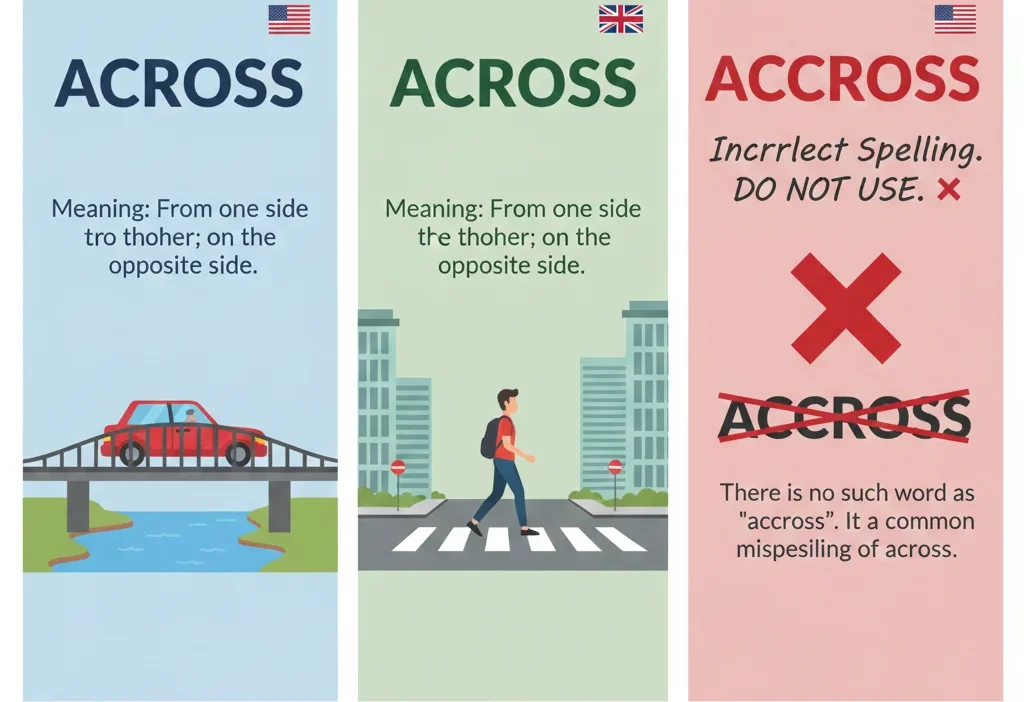
The correct spelling is “across”.
- “Accross” is a common misspelling and should be avoided.
- Meaning: It usually indicates movement from one side to the other, as in “I walked across the bridge.”
- Examples:
- Across bridge: “The car drove safely across the bridge.”
- Across network: “Data was shared across the network.”
- Across web3: “Transactions are validated across web3 platforms.”
💡 Remember: Whenever you want to indicate movement or distribution from one side to another, always use “across”, never “accross”.

The Origin of Across or Accross
The word “across” has been in the English language since the 14th century. It comes from the combination of “a” (meaning “on” or “in”) and “cross” (meaning “from one side to another”).
- Accross meaning: There is no official definition in English. It is simply a misspelling of across.
- Historically, spelling was not standardized, which is why we sometimes see variations like accross in older texts or informal writing.
Over time, dictionaries, style guides, and grammar authorities confirmed that “across” is the standard, universally accepted spelling in both British and American English.
British English vs American English Spelling
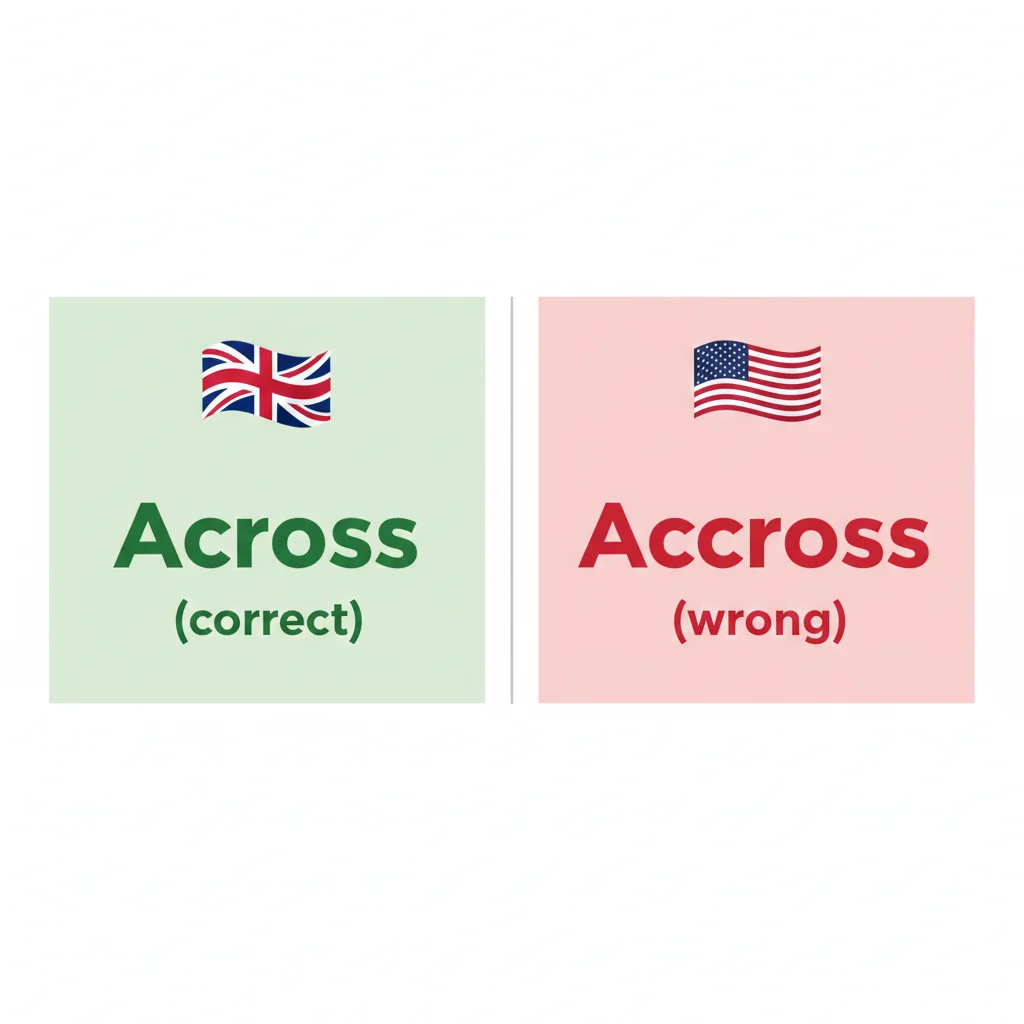
While some English words differ in UK vs US spelling (like colour vs color), “across” is spelled the same way in both.
Comparison Table:
| Word | British English | American English | Notes |
|---|---|---|---|
| Across | across | across | Correct spelling in both |
| Accross | ❌ | ❌ | Incorrect in all forms |
Key Takeaways:
- UK writers sometimes overthink spelling rules, but across is always correct.
- There is no variant “accross” in any English dictionary.
- Remember: When in doubt, type across.
Which Spelling Should You Use?
- US audience: Always across. Example: “Traffic was redirected across the bridge.”
- UK/Commonwealth audience: Always across. Example: “The news spread quickly across the network.”
- Global content: Stick to across, as it is universally recognized and avoids confusion.
Practical tip:
- If your audience is in finance, web3, or tech (e.g., using Across bridge explorer), correct spelling builds trust.
- Writing accross can look unprofessional in emails, articles, and formal writing.
Common Mistakes with Across or Accross
Many writers confuse across with:
- Accross – ❌ Always incorrect.
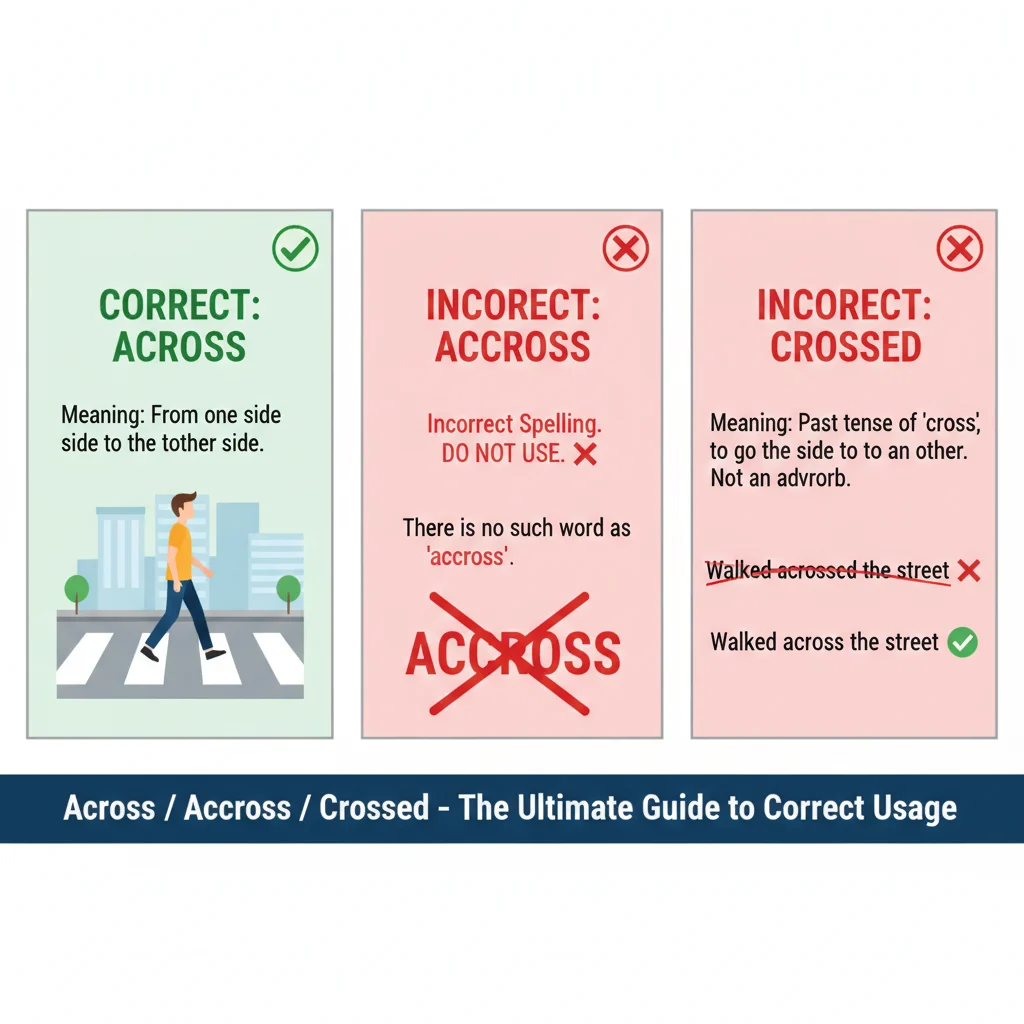
- Cross – ✅ “Cross” is a noun or verb meaning an intersection or to pass over.
- Example: “She crossed the street” vs “The river flows across the valley.”
- Acrossed – ❌ Incorrect. “Across” is not a verb, so it doesn’t take “-ed”.
Correct Usage Examples:
- “Funds were transferred across all networks.” ✅
- “Check the Across bridge explorer for transaction history.” ✅
- “She walked across the bridge.” ✅
Across or Accross in Everyday Examples
Emails:
- ✅ “I shared the report across the team.”
- ❌ “I shared the report accross the team.”
News headlines:
- ✅ “Wildfires spread across the region.”
Social media:
- ✅ “Exploring new opportunities across web3 platforms.”
Formal writing:
- ✅ “The information was distributed across the network efficiently.”
Tips: Always check your spelling before posting online. Even one extra “c” can hurt credibility.
Across the Board – Meaning and Usage
Meaning: The phrase “across the board” means applying to everyone or everything in a group, situation, or organization. It suggests something is universal or inclusive without exceptions.
Origin: This term comes from horse racing, where a bet “across the board” means wagering on a horse to win, place, or show. Over time, it expanded to general usage.
Correct Usage Examples:
- ✅ “The company announced salary increases across the board.”
- ✅ “New safety measures were implemented across the board in all factories.”
- ✅ “Prices have risen across the board due to inflation.”
In Business Context:
- “Management approved bonuses across the board this year.”
- “Training programs will be updated across the board for all departments.”
In Everyday Language:
- “The new policy affects students across the board.”
- “Support for the proposal grew across the board.”
💡 Memory Tip: Think of a board (like a bulletin board) that covers everything – if something is “across the board,” it touches every part.
Common Mistake:
❌ “The changes apply accross the board.” (Wrong spelling)
✅ “The changes apply across the board.” (Correct)
Across or Accross – Google Trends & Usage Data
- Across is searched worldwide, especially in the UK, US, India, and Canada.
- Terms like “Across bridge”, “Across network”, and “Across explorer” show increasing search interest in web3 and blockchain contexts.
- Accross is searched mostly by people unsure of the correct spelling or beginners in English.
Comparison Table (Keyword variations):
| Keyword Variation | Popularity | Correct/Incorrect |
|---|---|---|
| Across | High | ✅ Correct |
| Accross | Medium | ❌ Incorrect |
| Acrossed | Low | ❌ Incorrect |
| Across bridge | High | ✅ Correct |
| Across network | Medium | ✅ Correct |
| Across explorer | Medium | ✅ Correct |
| Across web3 | Low | ✅ Correct |
| Across all meaning | Medium | ✅ Correct |
| What is the meaning of Accross or across? | High | ✅ Correct usage in queries |
Across vs Through – Understanding the Difference
Many learners confuse “across” and “through.” Here’s how to use them correctly:
| Aspect | Across | Through |
|---|---|---|
| Meaning | Movement from one side to another on a surface | Movement inside or within something |
| Visual | Like walking on top of a bridge | Like walking inside a tunnel |
| Focus | Surface-level movement | Interior movement with obstacles |
Across Examples:
- ✅ “She swam across the river.” (On the surface)
- ✅ “He walked across the field.” (On top of the grass)
- ✅ “The bird flew across the sky.” (Through the air as a surface)
Through Examples:
- ✅ “She walked through the tunnel.” (Inside, surrounded)
- ✅ “He pushed through the crowd.” (Navigating between people)
- ✅ “Light filtered through the curtains.” (Passing inside)
Compare Side by Side:
| Context | Across | Through |
|---|---|---|
| Forest | “We trekked across the forest.” (From edge to edge) | “We trekked through the forest.” (Navigating between trees) |
| City | “He drove across the city.” (From one side to other) | “He drove through the city.” (Navigating streets) |
| Water | “She swam across the lake.” (Surface) | “Divers went through the water.” (Immersed) |
💡 Quick Memory Trick:
- Across = Surface (like a tabletop)
- Through = Inside (like a box)
Common Mistake:
❌ “We walked through the bridge.” (Wrong – bridges are surfaces)
✅ “We walked across the bridge.” (Correct)
❌ “The bullet went across his arm.” (Wrong – bullet goes inside)
✅ “The bullet went through his arm.” (Correct)
FAQs
- What is the meaning of “across”?
- Moving from one side to the other. Example: “I ran across the field.”
- Is accross ever correct to use?
- ❌ No. “Accross” is always a misspelling.
- When to use cross and across?
- “Cross” is a verb/noun: “I cross the road.”
- “Across” shows direction/location: “I ran across the road.”
- What does acrossed mean?
- ❌ Incorrect. “Across” does not take -ed.
- How do I remember the correct spelling?
- Think of it as “a + cross” → movement over something.
- Can I use across in web3 contexts?
- ✅ Yes. Example: “Transactions are verified across web3 networks.”
- Is “across all meaning” correct?
- ✅ Yes, in contexts like “These rules apply across all departments.”
Conclusion
In short, the correct spelling is always “across”. Forget about “accross” or “acrossed”—they are mistakes that can make your writing look unprofessional. Whether you’re talking about a bridge, a network, or exploring web3 platforms, using the right spelling ensures clarity and credibility.
British and American English both accept across, making it a universally safe choice for global audiences. Remember to avoid confusing it with cross, which serves a different grammatical function. Common mistakes include adding an extra “c” or using it as a verb, but with the examples in this guide, you can write confidently every time.
From emails to social media posts to technical writing, across is versatile and essential. If you ever feel unsure, think of movement from one side to another, and you’ll naturally reach for the correct form. Follow these tips, and you’ll never need to search “Is accross ever correct to use?” again.

Jon McGregor is an award-winning British novelist known for his poetic prose, vivid imagery, and deeply human storytelling.