Confused between compliment and complement? You’re not alone. These two words sound almost the same, but they have completely different meanings. Using the wrong one can easily change the meaning of your sentence and make your writing look incorrect.
A compliment is a kind word of praise or admiration you give to someone. For example: “She received a compliment on her beautiful dress.” In contrast, complement refers to something that completes, enhances, or goes well with something else. For example: “The sauce complements the flavor of the dish.”
Understanding the difference between compliment and complement can improve your writing clarity and confidence. In this guide, you’ll learn the exact meaning, simple examples, and easy tips to remember which word to use correctly in everyday writing.
Compliment or Complement Means
What is the difference between compliment and complement?
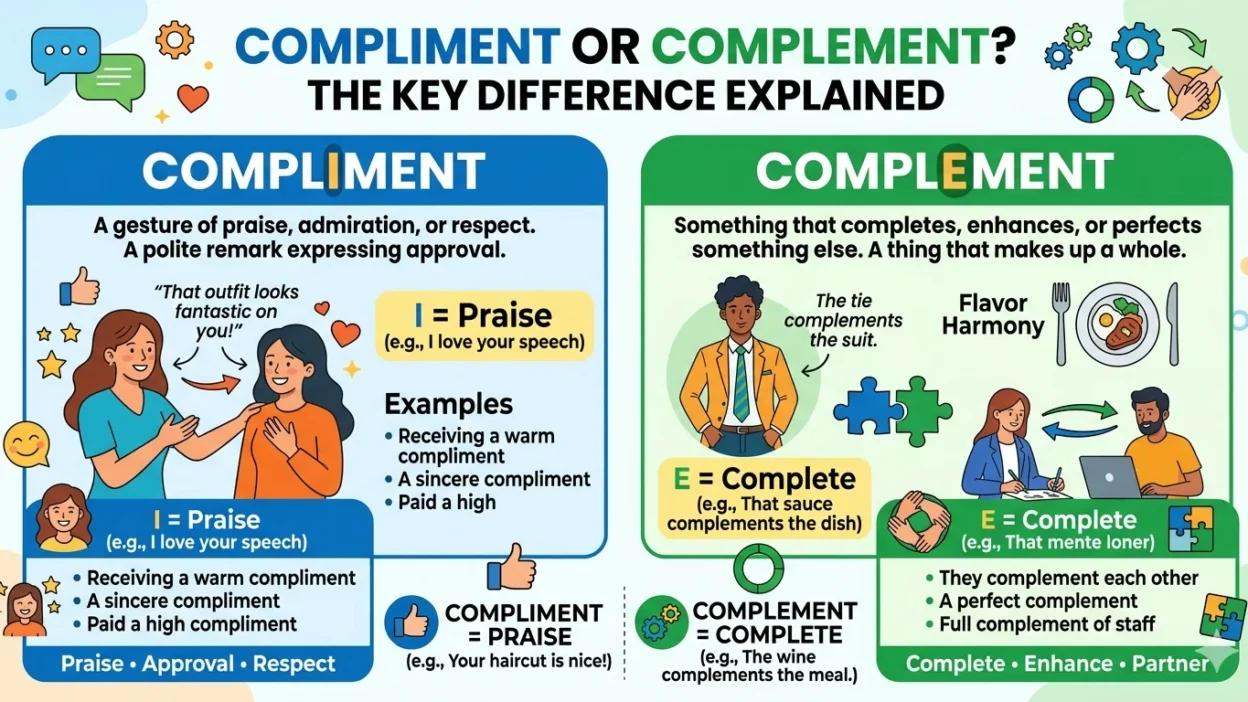
A compliment means praise, admiration, or a polite expression of approval.
A complement means something that completes, improves, or goes well with something else.
Examples
Compliment
- She gave me a compliment on my presentation.
- I want to compliment your excellent writing.
Complement
- The blue tie complements his suit.
- Her creativity complements the team perfectly.
Simple Rule
| Word | Meaning |
|---|---|
| Compliment | Praise someone |
| Complement | Complete or enhance something |
This simple rule explains the difference between compliment and complement with examples.
Easy Trick to Remember Compliment vs Complement
Many learners remember the difference using a small memory trick.
| Word | Memory Trick |
|---|---|
| Compliment | “I” in compliment → I praise you |
| Complement | “E” in complement → Enhance or complete |
This trick helps writers remember when to use compliment or complement in sentences.
The Origin of Compliment or Complement
Both words come from the Latin word “complere,” which means to fill up or complete.
Complement Origin
The word complement entered English in the 14th century and kept its original meaning of completing something or making it whole.
Example:
- The lighting complements the room design.
Compliment Origin
The word compliment later developed from the French word compliment, meaning a polite expression of praise or respect.
Example:
- She received a compliment on her speech.
Because both words come from the same root, they look and sound similar, which explains the common confusion around compliment or complement meaning.
British English vs American English Spelling
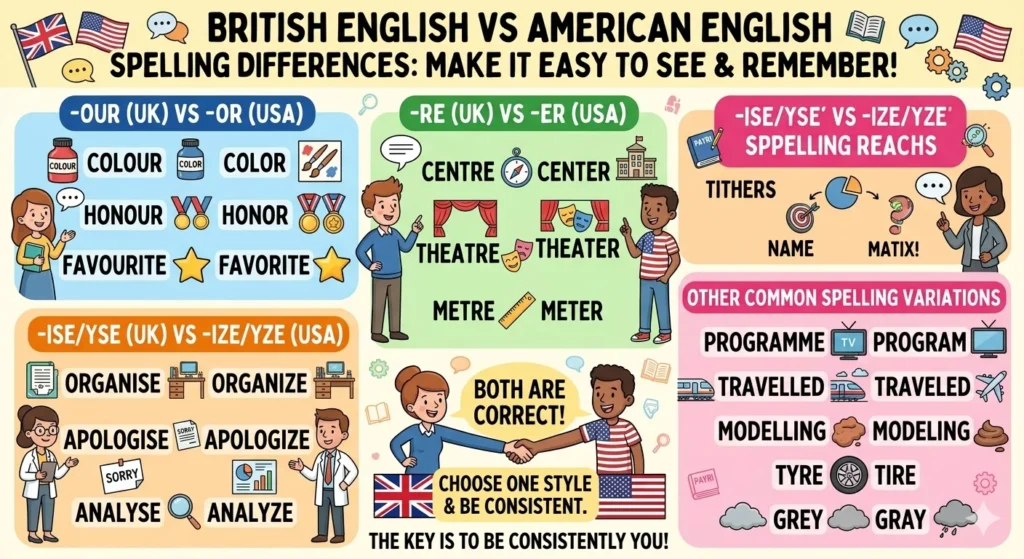
Unlike many English words, the spelling of compliment and complement is the same in British and American English.
Many people search compliment or complement UK, compliment or complement Australia, or which spelling is correct internationally.
The answer is simple: the spelling does not change by country.
Spelling Comparison Table
| Word | Meaning | Example | UK | US | Australia |
|---|---|---|---|---|---|
| Compliment | Praise or admiration | She gave me a compliment | ✔ | ✔ | ✔ |
| Complement | Something that completes | The color complements the design | ✔ | ✔ | ✔ |
| Complimentary | Free or praising | Complimentary drinks | ✔ | ✔ | ✔ |
| Complementary | Completing or matching | Complementary colors | ✔ | ✔ | ✔ |
So the difference between compliment or complement is based on grammar and meaning, not location.
Which Spelling Should You Use?
Choosing between compliment or complement depends entirely on the meaning of the sentence.
Use Compliment for Praise
Examples:
- She gave me a compliment about my presentation.
- I would like to compliment your creative design.
Use Complement for Completing Something
Examples:
- The red shoes complement her dress perfectly.
- His calm personality complements the energetic team leader.
Audience-Based Advice
| Audience | Spelling Rule |
|---|---|
| United States | Same grammar rule |
| United Kingdom | Same grammar rule |
| Australia | Same grammar rule |
| Global English | Follow the meaning rule |
This helps writers choose the correct spelling when asking which is correct compliment or complement.
Common Mistakes with Compliment or Complement
Many grammar mistakes occur because the words look and sound alike.
Mistake 1
❌ Your jacket compliments your outfit.
✅ Your jacket complements your outfit.
Mistake 2
❌ Thank you for the nice complement.
✅ Thank you for the nice compliment.
Mistake 3
❌ Staff compliment increased this year.
✅ Staff complement increased this year.
In business English, staff complement refers to the total number of employees in an organization.
Complementary vs Complimentary
These words are also related and often confused.
| Word | Meaning | Example |
|---|---|---|
| Complementary | Matching or completing something | Complementary colors |
| Complimentary | Free or given as courtesy | Complimentary breakfast |
Example:
- The hotel offers complimentary breakfast.
- The blue and yellow colors are complementary.
Compliment or Complement in Everyday Examples
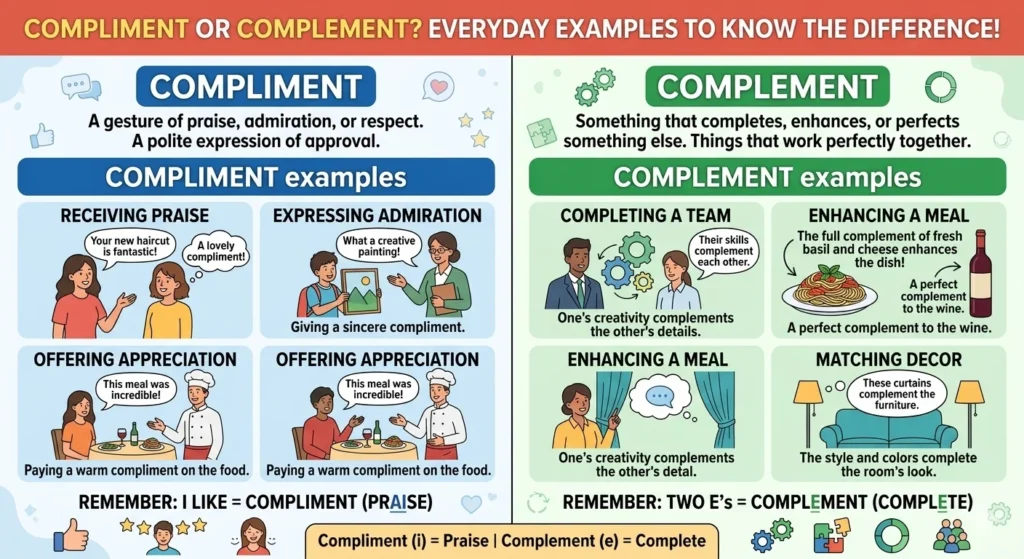
These words appear frequently in daily communication.
Email Example
“Thank you for the compliment on our customer service.”
Social Media Example
“The music complements the video perfectly.”
Business Writing Example
“Our team members complement each other well.”
News Writing Example
“The new park complements the city’s modern architecture.”
Sentence Examples
- She gave me a compliment on my presentation.
- The lighting complements the room design.
- His skills complement the project perfectly.
These examples help explain how to use compliment and complement in a sentence.
Compliment vs Complement Pronunciation
The pronunciation of both words is almost identical:
Compliment pronunciation:
KOM-pluh-ment
Complement pronunciation:
KOM-pluh-ment
Because they sound the same, the correct word must be chosen based on context and meaning.
Compliment or Complement – Google Trends & Usage Data
Search data shows that compliment or complement is one of the most commonly searched grammar questions.
Popular search queries include:
- is it compliment or complement
- compliment or complement grammar
- compliment or complement meaning
- how do you spell compliment or complement
Countries with High Search Interest
- United States
- United Kingdom
- Australia
- Canada
- India
Most searches come from students, bloggers, teachers, and professional writers who want to improve writing accuracy.
Compliment vs Complement Usage Table
| Situation | Correct Word | Example |
|---|---|---|
| Praise someone | Compliment | She gave me a compliment |
| Matching colors | Complement | Blue complements yellow |
| Free hotel breakfast | Complimentary | Complimentary breakfast |
| Matching design colors | Complementary | Complementary colors |
Related Grammar Guides
If you enjoy learning about confusing English words, you may also want to explore:
- Affect vs Effect
- Then vs Than
- Stationary vs Stationery
- Accept vs Except
Learning these word differences improves writing accuracy and grammar skills.
Why This Grammar Rule Matters
Language experts and major dictionaries such as Oxford English Dictionary and Merriam-Webster clearly explain the difference between compliment and complement.
Understanding this grammar rule helps writers avoid common mistakes in professional communication, academic writing, and online content.
FAQs
What is the difference between complement and compliment?
A compliment means praise or admiration, while a complement means something that completes or enhances something else.
Is free food complimentary or complementary?
Free food is complimentary, meaning it is provided for free.
What is an example of complement?
Example:
“The lighting complements the room design.”
How to use compliment and complement in a sentence?
Example:
“She gave me a compliment.”
“The colors complement each other.”
Is it compliment or complement of the season?
The correct phrase is “compliments of the season.”
What does staff complement mean?
A staff complement is the total number of employees in an organization.
Are compliment and complement pronounced the same?
Yes, they have almost identical pronunciation.
Conclusion
The difference between compliment or complement may seem small, but it is very important for clear and accurate writing. A compliment refers to praise or admiration given to someone, while a complement refers to something that completes or enhances something else.
Many writers confuse these words because they look and sound almost identical. However, remembering a simple rule can make the difference clear. Compliment contains the letter “I,” which can remind you of “I praise you.” Complement contains the letter “E,” which can remind you of “enhance or complete.”
Another important point is that the spelling does not change between British English, American English, or Australian English. The grammar rule remains the same everywhere. This makes it easier for global writers and English learners to use the words correctly.
By understanding compliment vs complement meaning, pronunciation, examples, and grammar rules, you can confidently choose the correct word in emails, professional documents, social media posts, and academic writing.
Mastering small grammar differences like this greatly improves clarity, credibility, and professional communication.

Jon McGregor is an award-winning British novelist known for his poetic prose, vivid imagery, and deeply human storytelling.