Many English learners confuse compliment and complement because they sound exactly alike, but their meanings are completely different. Using the wrong word can change the meaning of your sentence and make your writing look unprofessional.
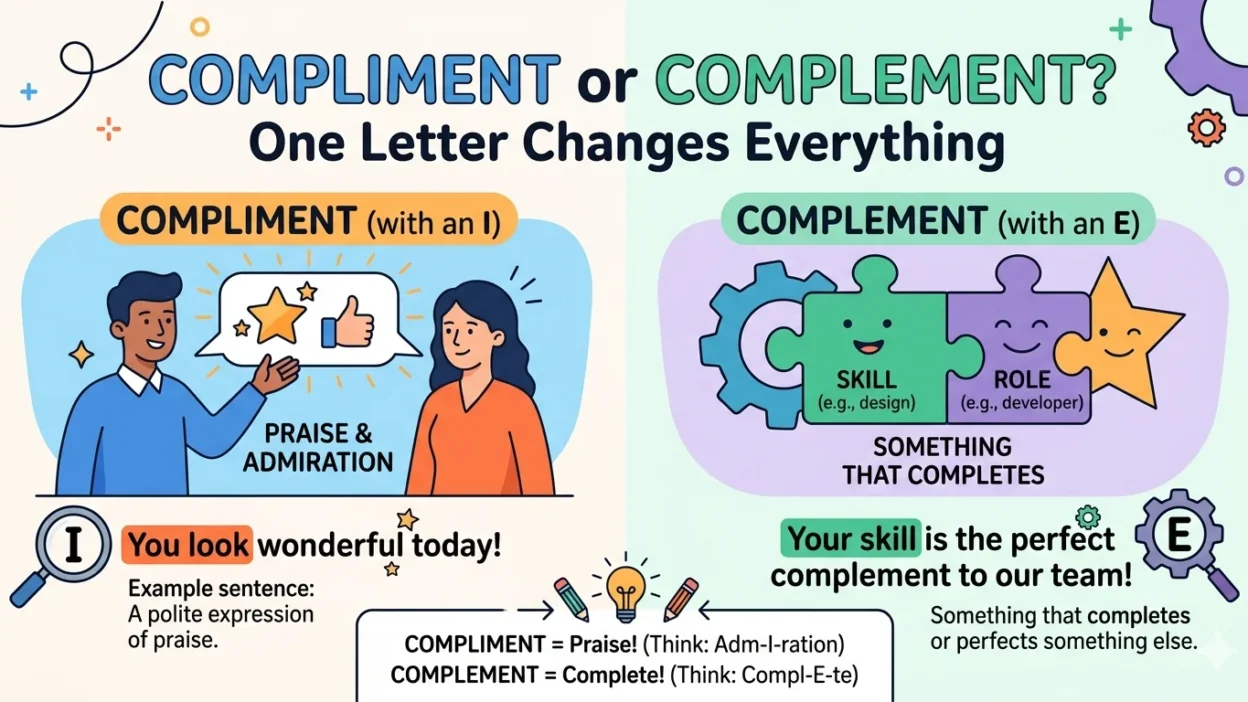
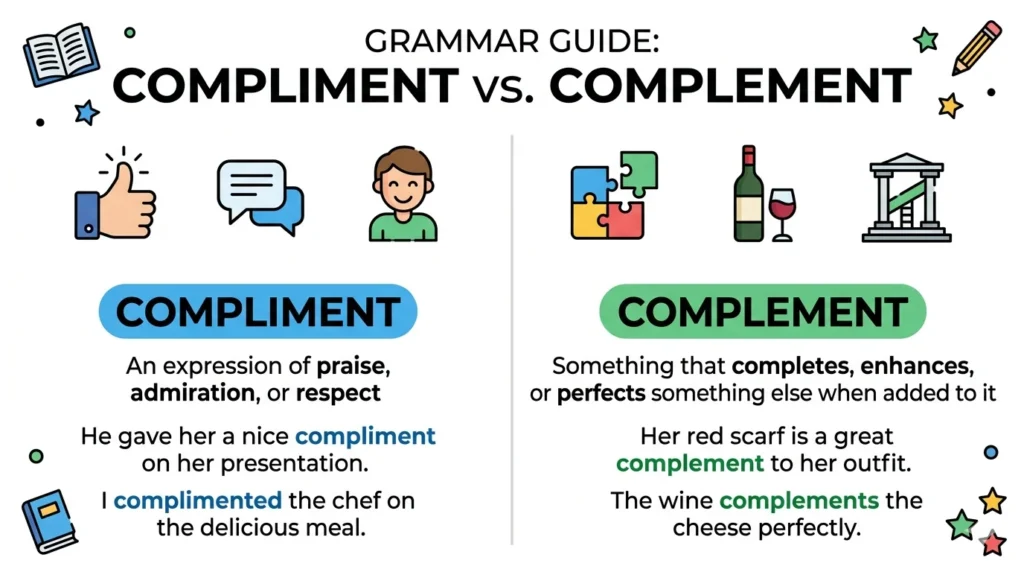
A compliment is a polite praise or kind remark, such as “She gave me a compliment on my writing.” On the other hand, complement means something that completes, improves, or goes well with something else, like “The sauce complements the dish perfectly.”
Understanding the difference between compliment and complement helps you avoid one of the most common English mistakes. In this guide, you’ll learn the correct meanings, simple examples, grammar tips, and easy memory tricks to remember which word to use every time. ✨
Compliment or Complement – Means Answer
The main difference is simple:
| Word | Meaning | Example |
|---|---|---|
| Compliment | Praise or kind words | “She gave me a nice compliment.” |
| Complement | Something that completes or matches | “The sauce complements the pasta.” |
Quick Trick to Remember
- Compliment = praise
- Complement = complete
Examples
- “Your dress looks beautiful.” → This is a compliment.
- “The black shoes complement the outfit.” → This means the shoes match well.
Many users search for compliment or complement meaning because these words are homophones. They sound alike but have different definitions.
The Origin of Compliment or Complement
The words compliment and complement both come from Latin roots, which is why they look similar today.
Origin of Compliment
The word compliment came from the Latin word complere through French and Italian influences. Over time, it developed the meaning of polite praise or admiration.
Example:
- “He complimented her cooking.”
Origin of Complement
The word complement also came from the Latin complere, meaning “to complete.” It kept the meaning of making something whole or perfect.
Example:
- “The wine complements the meal.”
Why the Spelling Difference Exists
English borrowed both words from different language paths. Their meanings changed over centuries, but the similar spelling remained. That is why people often confuse them today.
This confusion also appears in phrases like:
- Is it compliment or complement of the season?
- Staff compliment or complement
- Complementary vs complimentary
British English vs American English Spelling
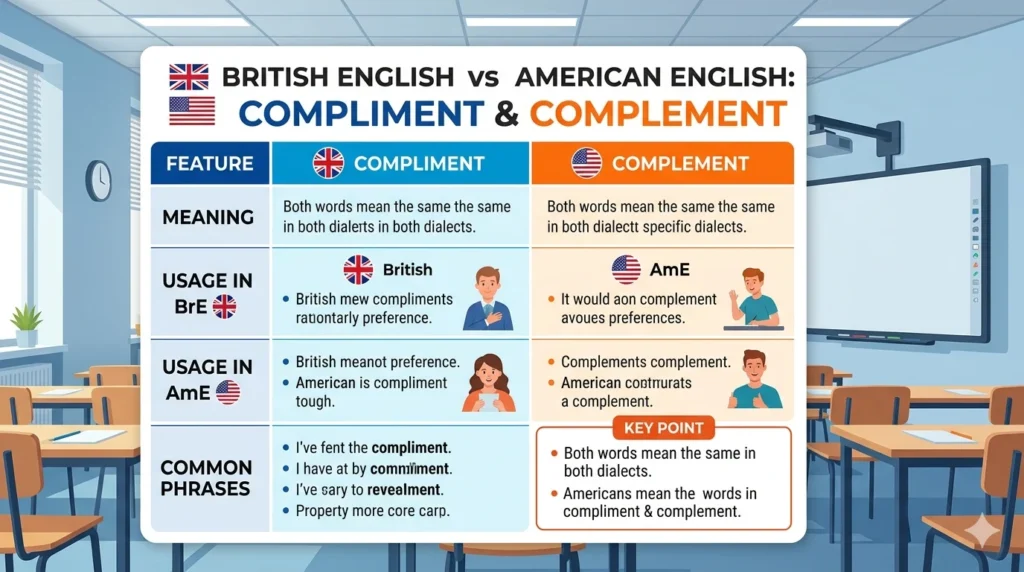
The good news is that both British English and American English use the same spelling rules for compliment and complement.
However, usage style can differ slightly in business and formal writing.
Comparison Table
| Topic | British English | American English |
|---|---|---|
| Compliment meaning | Praise | Praise |
| Complement meaning | Complete or match | Complete or match |
| Complimentary | Free or praising | Free or praising |
| Complementary | Matching or completing | Matching or completing |
| Common business use | Complimentary breakfast | Complimentary breakfast |
Compliment or Complement UK
In the UK, the meanings stay exactly the same:
- Compliment = praise
- Complement = complete or improve
Example:
- “Your tie complements your jacket.”
- “Thank you for the compliment.”
So if you search compliment or complement UK, the answer is the same as in US English.
Which Spelling Should You Use?
The correct spelling depends on the meaning you want.
Use “Compliment” When Talking About Praise
Examples:
- “She gave me a compliment.”
- “Thank you for the compliment.”
- “He complimented my work.”
Use “Complement” When Talking About Matching or Completing
Examples:
- “The curtains complement the room.”
- “These colors complement each other.”
- “The team members complement each other’s skills.”
Audience-Based Advice
| Audience | Recommended Usage |
|---|---|
| US audience | Follow standard meanings |
| UK audience | Same standard meanings |
| Global audience | Use simple examples for clarity |
| Business writing | Double-check context carefully |
| Academic writing | Use precise grammar rules |
If you are unsure, replace:
- compliment with “praise”
- complement with “complete”
That quick test usually works.
Common Mistakes with Compliment or Complement
Many writers accidentally swap these words.
Mistake #1: Using Compliment Instead of Complement
❌ “The blue tie compliments the suit.”
✅ “The blue tie complements the suit.”
Reason: The tie matches the suit, not praises it.
Mistake #2: Using Complement Instead of Compliment
❌ “She gave me a nice complement.”
✅ “She gave me a nice compliment.”
Reason: She praised you.
Mistake #3: Complimentary vs Complementary
This is another common confusion.
| Word | Meaning |
|---|---|
| Complimentary | Free or praising |
| Complementary | Matching or completing |
Examples
- “The hotel offers complimentary breakfast.”
→ Free breakfast - “The colors are complementary.”
→ The colors match well
This answers the question:
Is free food complimentary or complementary?
The correct word is complimentary because the food is free.
Compliment or Complement in Everyday Examples

Understanding real-life examples makes grammar easier.
In Emails
- “Thank you for the compliment.”
- “Your skills complement our team.”
In News Articles
- “The coach complimented the players.”
- “The new policy complements existing laws.”
On Social Media
- “Everyone complimented her dress.”
- “The music complements the video perfectly.”
In Formal Writing
- “This research complements previous studies.”
- “The manager complimented the employee’s performance.”
Use Compliment and Complement in a Sentence
Compliment Sentence
- “She complimented my presentation.”
Complement Sentence
- “The dessert complements the dinner.”
Compliment or Complement – Google Trends & Usage Data
Search interest for compliment or complement remains high because these words confuse millions of English learners.
Most Popular Searches
People often search:
- What is the difference between complement and compliment?
- Compliment or complement meaning
- Difference between compliment and complement with examples
- Complementary vs complimentary
- Are compliment and complement pronounced the same?
Usage by Country
| Country | Common Search Trend |
|---|---|
| United States | Grammar correction |
| United Kingdom | Business writing |
| Canada | School assignments |
| India | English learning |
| Pakistan | Competitive exams and blogging |
Are Compliment and Complement Pronounced the Same?
Yes. They are almost pronounced the same. That is why they are called homophones.
Pronunciation similarity causes many spelling mistakes in English writing.
Difference Between Compliment and Complement With Examples
| Compliment | Complement |
|---|---|
| Means praise | Means complete or match |
| Related to admiration | Related to balance |
| “Nice haircut!” | “The sauce complements the pasta.” |
| Emotional meaning | Functional meaning |
| Used in conversations | Used in design, fashion, writing |
What Is the Difference Between Supplement and Compliment?
Many users also confuse supplement with compliment.
| Word | Meaning |
|---|---|
| Supplement | Extra addition |
| Compliment | Praise |
| Complement | Something that completes |
Examples
- “Vitamin tablets supplement your diet.”
- “She gave me a compliment.”
- “The shoes complement the outfit.”
FAQs About Compliment or Complement
What is the difference between complement and compliment?
Compliment means praise. Complement means something that completes or matches something else.
Is free food complimentary or complementary?
The correct word is complimentary because it means free.
How do you use complement and compliment in a sentence?
- Compliment: “He complimented my painting.”
- Complement: “The frame complements the painting.”
Are compliment and complement pronounced the same?
Yes, they sound almost identical in spoken English.
Is it compliment or complement of the season?
The correct phrase is compliments of the season because it expresses polite greetings or praise.
What does complementary mean?
Complementary means matching or completing something perfectly.
Example:
- “The two colors are complementary.”
What does complimentary mean?
Complimentary means free or expressing praise.
Example:
- “Guests received complimentary drinks.”
Conclusion
The confusion between compliment or complement is very common because both words look and sound similar. However, their meanings are completely different. A compliment is a kind word, praise, or admiration, while a complement is something that completes, improves, or matches another thing perfectly.
A simple memory trick can help you forever:
- Compliment = praise
- Complement = complete
This difference matters in emails, school writing, professional communication, social media posts, and business documents. Using the wrong spelling may confuse readers or make your writing appear less professional.
You should also remember the difference between complimentary vs complementary. Free services are complimentary, while matching things are complementary.
Whether you write for American, British, or global audiences, the spelling rules stay the same. The best way to avoid mistakes is to focus on the meaning of the sentence before choosing the word.
Now you can confidently use compliment and complement correctly in everyday English writig.

Daisy Johnson is a creative writer who crafts vivid similes and poetic expressions to help readers enrich their language and imagination.