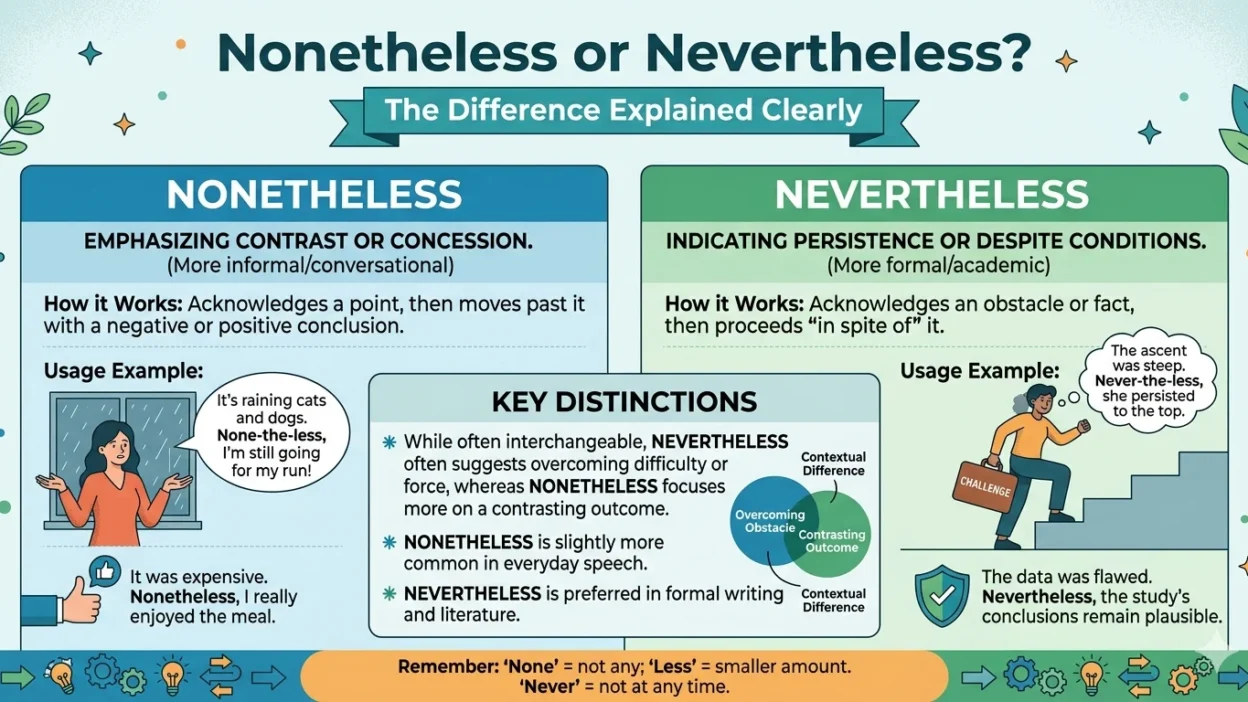
Nonetheless and nevertheless both mean “in spite of that” or “however,” and in most cases, they can be used interchangeably. The difference between them is very small and mostly about tone rather than meaning.
Nonetheless is slightly more common in modern and informal writing, while nevertheless often sounds a bit more formal or traditional. For example: “It was raining; nonetheless, we went out” and “It was raining; nevertheless, we went out.” Both sentences are correct and have the same meaning.
Understanding the difference between nonetheless and nevertheless helps you choose the right tone in your writing. In this guide, you’ll learn usage, examples, tone differences, and easy tips to use both correctly every time
Nonetheless or Nevertheless – Means
Both “nonetheless” and “nevertheless” mean the same thing:
👉 “in spite of that” or “even so”
Examples:
- The task was hard. Nonetheless, she finished it.
- It was raining. Nevertheless, they went outside.
✔️ They are interchangeable in most cases.
✔️ Both are formal transition words.
✔️ Both show contrast between two ideas.
The Origin of Nonetheless or Nevertheless
Both words come from combining three smaller words:
- None + the + less → Nonetheless
- Never + the + less → Nevertheless
Historically, they developed in Middle English. Over time, both forms became standard in formal writing. The difference in spelling exists because they evolved from different base words (“none” vs “never”), but their meanings merged.
Today, there is no major difference in meaning, only slight preference in tone.
British English vs American English Spelling
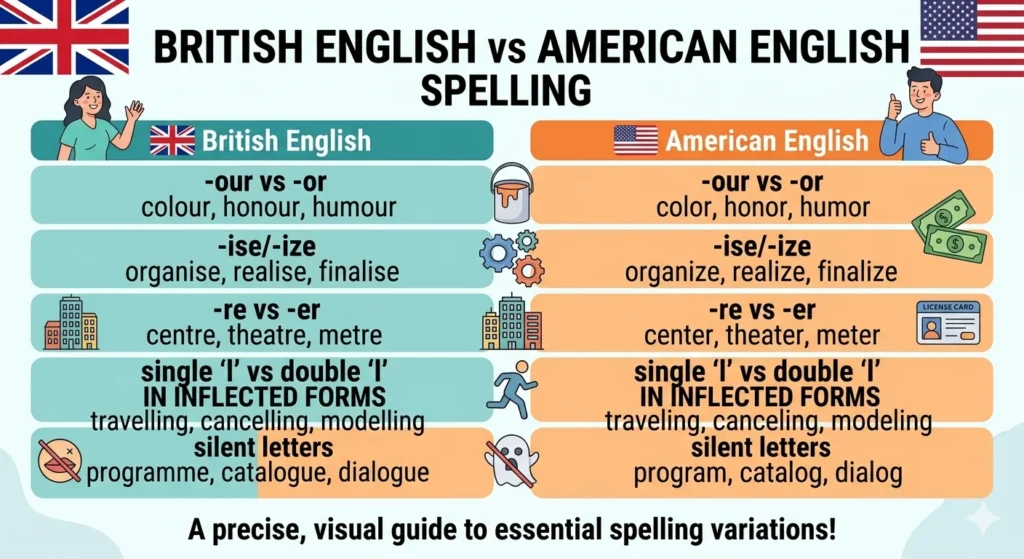
Good news:
👉 There is NO spelling difference between British and American English.
Both regions use:
- Nonetheless ✅
- Nevertheless ✅
Comparison Table
| Feature | Nonetheless | Nevertheless |
|---|---|---|
| Meaning | Same | Same |
| Usage | Formal | Formal |
| US English | Common | Common |
| UK English | Common | Common |
| Tone | Slightly lighter | Slightly more formal |
Which Spelling Should You Use?
Here’s simple advice:
- Use “nevertheless” → for academic, formal, or professional writing
- Use “nonetheless” → for slightly simpler or modern tone
Audience Guide:
- 🇺🇸 US audience → Either is fine
- 🇬🇧 UK/Commonwealth → Either is fine
- 🌍 Global writing → Prefer nonetheless (easier and shorter)
👉 If unsure, choose nonetheless for clarity.
Common Mistakes with Nonetheless or Nevertheless
❌ Mistake 1: Using both together
Wrong:
- Nonetheless, nevertheless, he agreed.
✔️ Correct:
- Use only one.
❌ Mistake 2: Wrong sentence position
Wrong:
- He nonetheless was tired but worked.
✔️ Correct:
- He was tired. Nonetheless, he worked.
❌ Mistake 3: Confusing with “however”
“However” is more flexible and common.
✔️ Example:
- He was tired. However, he worked.
- He was tired. Nevertheless, he worked.
Counsellor or Counselor? The Correct Spelling Explained Clearly
Nonetheless or Nevertheless in Everyday Examples
Emails:
- The deadline is tight. Nonetheless, we will complete it.
News:
- The economy slowed. Nevertheless, growth continued.
Social Media:
- It’s difficult. Nonetheless, keep going 💪
Formal Writing:
- The results were limited; nevertheless, they are valuable.
Nonetheless or Nevertheless – Google Trends & Usage Data
- Nevertheless → More common in academic writing
- Nonetheless → More popular in blogs and online content
- Both are widely used in:
- USA 🇺🇸
- UK 🇬🇧
- Canada 🇨🇦
- Australia 🇦🇺
👉 Modern trend:
“Nonetheless” is slightly increasing in digital content because it is shorter and easier to read.
Comparison Table (Keyword Variations)
| Phrase | Meaning | Usage Example |
|---|---|---|
| Nonetheless meaning | In spite of that | It was late; nonetheless, he stayed |
| Nevertheless meaning | Even so | It failed; nevertheless, we tried |
| Nonetheless synonym | However, still | Still, she continued |
| Nevertheless synonym | Even so, yet | Yet, he agreed |
| Nonetheless in a sentence | Contrast use | He was tired; nonetheless, he worked |
| Nevertheless examples | Formal contrast | It was risky; nevertheless, they acted |
FAQs
1. Is nevertheless and nonetheless the same thing?
Yes. Both have the same meaning: in spite of that.
2. Is nonetheless or nevertheless better?
Neither is better. Use nonetheless for simple tone and nevertheless for formal tone.
3. How to use nonetheless and nevertheless in a sentence?
Place them after a contrast:
- It was hard. Nonetheless, she succeeded.
4. When to use however, nevertheless, nonetheless?
- Use however for common writing
- Use nonetheless/nevertheless for formal emphasis
5. Is nonetheless more formal?
Yes, but nevertheless is slightly more formal.
6. Can I use them in academic writing?
Yes. Both are excellent for essays and research papers.
7. What are synonyms of nonetheless or nevertheless?
- However
- Still
- Even so
- Yet
Conclusion
Choosing between nonetheless or nevertheless is much easier than it seems. Both words mean the same and can be used to show contrast in a sentence. The real difference lies in tone and style. If you want a slightly more formal and traditional feel, go with nevertheless. If you prefer something shorter and clearer, nonetheless is a great choice.
In modern writing, clarity matters more than complexity. That’s why many writers today lean toward nonetheless. However, both words remain powerful tools in formal English, especially when you want to connect ideas smoothly and professionally.
Remember: avoid overusing them, place them correctly in sentences, and choose based on your audience. Mastering these small details can improve your writing quality, boost readability, and help you rank better in search results in 2026.

Jon McGregor is an award-winning British novelist known for his poetic prose, vivid imagery, and deeply human storytelling.